How many auto repair shops are there in France? 69,062 in 2026
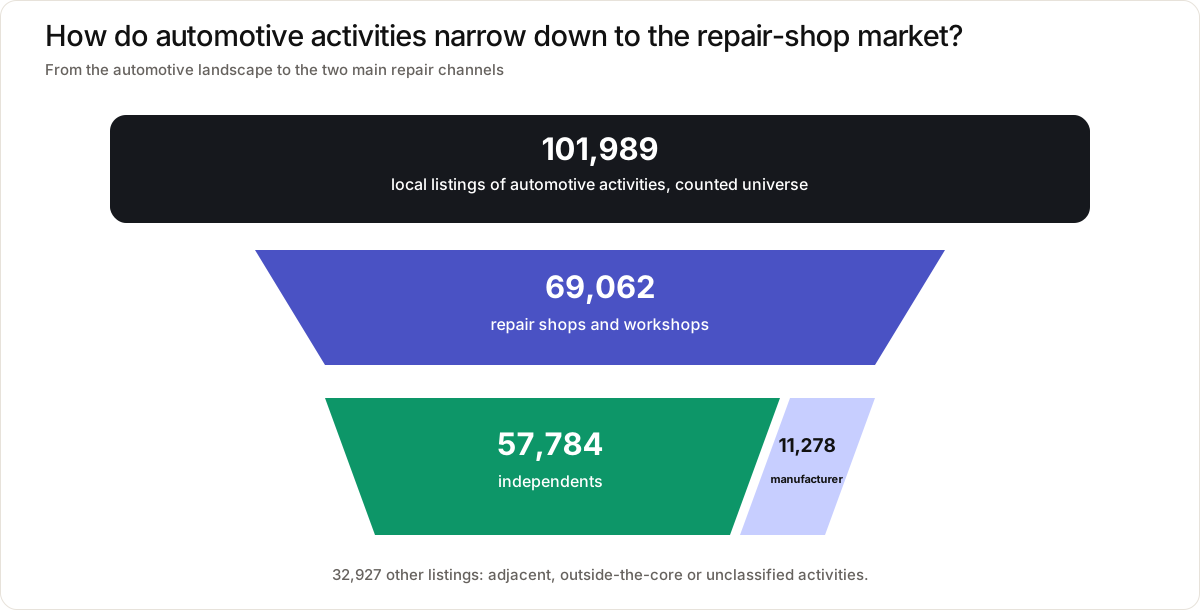
101,989 automotive activities counted. Among them, 69,062 repair shops and workshops, of which 57,784 independents, including 36,483 all-makes repair shops, of which 25,590 have no established banner.
The study counts 69,062 repair shops and workshops: 57,784 independents and 11,278 businesses in the manufacturer channel. Among the independents, 36,483 all-makes repair shops, of which 25,590 have no established banner. The extended automotive universe counts 101,989 local activities.
Published September 2, 2026 · September 3, 2026 edition · Detailed method added September 14, 2026 · Analysis closed August 31, 2026
The short answer#
| Question | Figure to remember |
|---|---|
| How many repair shops and workshops in mainland France? | 69,062 |
| How many independent repair shops? | 57,784 |
| How many manufacturer-network businesses? | 11,278 |
| How many independent all-makes repair shops? | 36,483 |
| How many independent all-makes shops with no established banner? | 25,590 |
| How many listings in the extended automotive universe? | 101,989, counted |
| How many adjacent, outside the core or unclassified? | 32,927 |
The right answer depends on the question. To know how many places can service or repair a car, the benchmark is 69,062. To size an offer aimed at repair shops outside the manufacturer channel, it is 57,784. To address the core of all-makes repair, the shops that buy their parts and services without going through a network, it is 25,590. To study every local automotive service, including sales, inspection, washing and recycling, the count covers 101,989 listings.
Why does the number of repair shops in France seem so variable?#
Published figures on the automotive aftermarket do not always measure the same thing. The difference comes first from the object counted: a business in the economic sense, an employer location, or a local point of activity. It comes next from the scope: repair only, sales and repair, the automotive services industry, or the extended automotive universe.
Take a simple example: one company operates ten repair shops under a single management. In an economic statistic from INSEE, the whole may count as one enterprise. In a territorial analysis, the ten addresses count as ten points of activity. In an ANFA publication, the figure depends on the indicator studied: enterprises, employer locations, employees, hires or apprentices. All three readings are correct, but they do not answer the same question.
| Reading | What is actually counted | The question it answers | Example of use |
|---|---|---|---|
| ANFA | Depending on the publication: enterprises in the industry, employer locations, employees, occupations or apprentices | How many people work in automotive services? Which trades are hiring? | Anticipating demand for mechanics, or tracking apprenticeships |
| INSEE | In structural statistics: the profiled enterprise under the 2008 decree, which may combine several companies and several locations; in the business register: legal units and administrative establishments | What economic weight does the sector carry? How many enterprises or registered establishments exist? | Measuring revenue, value added, employment or business demography |
| Scalon Observatory | One local listing matching a visible point of activity | Where are the players? What trade does each site practice? Which channel and which banner does it belong to? | Mapping the market, segmenting outreach, or measuring territorial presence |
These readings complement each other. For sector revenue, read INSEE. For employment, trades and training, read ANFA. To know how many local sites can be visited, mapped or compared, count local listings. Comparing their totals without keeping the unit means comparing enterprises, jobs and addresses as if they were the same thing.
The gaps, with the figures
| Publication | Published figure | What the figure means | Why it differs from 69,062 repair shops |
|---|---|---|---|
| ANFA, automotive sales and repair, sector page accessed September 2026 | 128,000 enterprises, 336,350 employees | The broad set of passenger-vehicle sales and repair: vehicle sales, repair and associated activities | A wider scope than workshops alone, and the unit is the enterprise, not the local address |
| ANFA, Autofocus 105, October 2023 | 53,000 employer locations | Industry sites employing passenger-vehicle mechanics or technicians | Excludes businesses with no employees; the same study mentions close to 40,000 locations without employees |
| INSEE, sector 452, 2021 data | 57,283 enterprises, €24.3B revenue | Enterprises in the economic sense whose main activity is vehicle maintenance and repair | One enterprise may operate several locations; workshops filed mainly under vehicle sales may sit in another sector |
| Scalon Observatory, 2026 | 57,784 independents, of which 36,483 all-makes shops and 25,590 with no banner; 69,062 repair shops in total, within an extended universe of 101,989 counted listings | Local points of activity where maintenance or repair is the core of the offer, whatever their legal form or employer status | Counts visible locations and separates the repair core from adjacent automotive activities |
There is therefore no single "official figure" that cancels the others. 53,000 answers "how many employer sites put mechanics to work?"; 57,283 answers "how many economic enterprises fall mainly under sector 452?"; 69,062 answers "how many local points make up the repair-shop market?"; 128,000 answers a broader reading of automotive sales and repair.
What is the revenue of vehicle maintenance and repair?#
The INSEE sector sheet for sector 452 measures €24.3 billion in revenue, excluding tax, in 2021. The same year it counts 57,283 enterprises and 117,414 full-time-equivalent jobs. At sector level, the operating margin rate reaches 20.4% and return on capital 12.9%.
These indicators describe an aggregated economic sector, not the revenue or profitability of a typical repair shop. They must therefore not be divided by the 69,062 local points in this observatory: one enterprise may operate several workshops, and the INSEE scope depends on the declared main activity.
Which activity code covers an auto repair shop?#
France classifies businesses under the NAF, its national activity nomenclature, the equivalent of the American NAICS. The code most directly attached to a light-vehicle repair shop is 45.20A, maintenance and repair of light motor vehicles. 45.20B covers maintenance and repair of other motor vehicles, mainly heavy trucks. Both belong to class 45.20 of the INSEE nomenclature.
"NAF code" and "APE code" name two faces of the same classification: the NAF is the nomenclature, while the APE code identifies the main activity assigned to an enterprise or a location. A repair shop may nevertheless fall under another code when its declared main activity is, for instance, vehicle or equipment sales. This is why a filter limited to 45.20A does not, on its own, rebuild the local repair-shop market.
To read the market without mixing denominators, this observatory follows six successive levels:
- The extended automotive universe, which gathers every relevant local listing.
- Repair shops and adjacent activities, which separate repair from the rest.
- The channel, which distinguishes independents, manufacturer networks and out-of-scope cases.
- The type, which describes the dominant activity of the business.
- The banner, which marks a proven local affiliation.
- Geography, which distributes the market across regions.
Each level answers a different question. Working down this hierarchy avoids two common confusions: taking every automotive activity for a repair shop, and taking every banner for a manufacturer brand.
The vocabulary of this market, in plain terms#
| Term | Plain definition |
|---|---|
| Enterprise, in the INSEE sense | The smallest combination of legal units with decision-making autonomy, under the 2008 decree. It may combine several companies and several locations. To be distinguished from the legal unit, a company ID, and from the establishment, a location ID. |
| Local listing | A visible presence attached to a place, a name and usually an address or a contact, whose activity is observed at the time of analysis. This is the unit counted here. A multi-site company may hold several listings. |
| Active | The business is trading at the date of this edition. Closed, wound-up or dormant sites are removed from the count, and therefore appear in none of the figures published here. |
| Repair shop | A business whose main activity is maintaining or repairing vehicles. In this study the term covers the workshops at the core of the market. |
| All-makes independent | A general workshop servicing several makes, known in France as an MRA. The term describes the trade and says nothing about the channel. |
| Franchised agent | A repairer officially tied to a manufacturer, often focused on maintenance and aftersales, without necessarily having the commercial setup of a dealership. |
| Manufacturer dealership | A business officially attached to a manufacturer and organized around new-vehicle distribution, usually with an aftersales workshop. |
| Auto center | A site combining a retail space for parts or accessories with an in-house workshop. |
| Tire shop | A business whose main trade is selling, fitting and servicing tires. Offering tires among many services is not enough to define this type. |
| Body shop | A workshop mainly dedicated to panel work, collision repair or automotive paint. |
| Specialist | A workshop centered on one technique or one vehicle category that does not match a more precise type in the nomenclature. |
| Channel | The commercial attachment of the repair shop: independent or manufacturer. "Out of scope" and "unclassified" are processing statuses, not trades or networks. |
| Independent | A repair shop outside any manufacturer's official channel. It may be fully autonomous, franchised, or affiliated to an all-makes banner: "independent" describes its channel, not the absence of any commercial brand, nor its legal status. |
| Banner | A service network displayed and proven locally, for instance an all-makes program. An independent may belong to a banner without becoming a manufacturer's agent. |
| Outside the core | A genuine automotive activity that sits outside the core of routine light-vehicle maintenance and repair. It may still matter to some players without being a repair shop in the usual sense. |
Outside the core describes an activity in the extended universe that is not a repair shop in the sense used here, for instance a standalone inspection center or a parts trader with no workshop. In the analysis, those cases receive the status out of scope; unclassified means instead that the available evidence does not allow a decision.
Level 1. The extended automotive universe: 101,989 local listings#
The starting point is a counted universe of 101,989 local listings in mainland France. It represents the visible automotive landscape in the broad sense, not repair shops alone: repair, sales, inspection, roadside assistance, washing, parts, recycling and assorted specialties.
In practice, an all-makes independent, a body shop, an auto center or a dealership with a workshop belongs to the repair-shop market. A vehicle inspection center, a salvage yard, a car wash or a parts trader with no workshop belongs to the extended automotive universe, but not to the repair core. An insufficiently documented activity stays in the observed universe without being forced into a category.
| Level | Examples included | Examples excluded |
|---|---|---|
| Extended automotive universe, 101,989 | Repair shops, dealerships, inspection centers, vehicle sales, washing, roadside assistance, parts, recycling | Activities with no identifiable local automotive link |
| Repair shops and workshops, 69,062 | All-makes independents, agents, dealerships with a workshop, body shops, tire shops, auto centers, glass, quick service | Standalone inspection, standalone washing, salvage, sales alone with no established workshop |
| Independent repair shops, 57,784 | Workshops outside the manufacturer channel, with or without an all-makes banner | Agents and dealerships officially attached to a manufacturer |
| Manufacturer channel, 11,278 | Franchised agents, dealerships and other officially attached sites | An all-makes service banner with no manufacturer mandate |
This distinction is decisive for any market study. A technical parts supplier, an insurer, a maintenance platform and a used-vehicle player do not share the same addressable market. All can start from the same extended universe, but each must then keep only the activities matching its offer.
A local listing is not an enterprise either. It represents an identifiable point of activity. That unit suits territorial strategy, local outreach, network management or presence analysis. It does not replace enterprise statistics when the question concerns accounts, employment or legal demography.
Level 2. Repair shops and adjacent activities#
Within the extended universe, 69,062 listings match repair shops and workshops. The remaining 32,927 listings represent adjacent activities, businesses outside the core, and cases that cannot responsibly be placed inside the repair core.
The repair-shop market then splits into 57,784 independents and 11,278 businesses in the manufacturer channel. These two categories rebuild the total of 69,062. The type, banner and regional segmentations below all use this same national denominator.
Level 3. The channel: independent or manufacturer#
The channel answers a question of attachment, not a question of trade. A body shop, an auto center or a tire shop can be independent. A general workshop can belong to a manufacturer. An all-makes banner can organize independents without turning them into franchised agents.
In this study, independent means precisely "outside a manufacturer's official channel". It does not mean "without a banner", "isolated company" or "outside any group". AD, Point S and Bosch Car Service are examples of service banners whose local members stay independent when they hold no manufacturer mandate. Eurorepar, Motrio and Motorcraft are tied to automotive groups; that ownership is not enough to place every member automatically in the manufacturer channel. It is the local mandate, agent, dealership or other official attachment, that decides. Conversely, an agent or a dealership officially attached to a vehicle brand always belongs to the manufacturer channel.
Here is the national distribution of the 69,062 repair shops across the two commercial channels:
| Channel | Repair shops | Share |
|---|---|---|
| Independent | 57,784 | 83.7% |
| Manufacturer network | 11,278 | 16.3% |
| Total | 69,062 | 100.0% |
Every share in this study is computed on the headcounts shown, then rounded to one decimal; their visible sum is therefore not always exactly 100%.
The market is overwhelmingly independent: more than four out of five repair shops fall outside a manufacturer's official channel.
The "manufacturer network" channel gathers businesses whose current attachment to a manufacturer is established. The "out of scope" status does not mean the business has no economic value: it only indicates that its dominant activity falls outside the target of light-vehicle maintenance and repair. "Unclassified" means the available information does not allow a responsible decision.
The type answers "what does this site do?", the channel answers "does it depend on a manufacturer?", and the banner answers "under which service network does it present itself?". One business can therefore be an all-makes independent, independent, and under a banner, all at once.
In this study's operating definition, an all-makes repair shop is first of all a general, multi-brand trade. Of 36,595 all-makes repair shops, 36,483, or 99.7%, are in the independent channel; 112 atypical cases belong to the manufacturer channel while showing that trade profile locally. Of 3,818 "other" specialists, 3,759 are independent and 59 belong to the manufacturer channel. For a campaign or a portfolio, type and channel must therefore always be kept as two separate filters.
Level 4. The type: what is the dominant trade?#
The type describes the main visible activity. It necessarily simplifies mixed cases: an all-makes independent may also fit tires, a body shop may do mechanical work, and a dealership may sell used vehicles. The classification keeps the dominant trade so that comparisons remain possible.
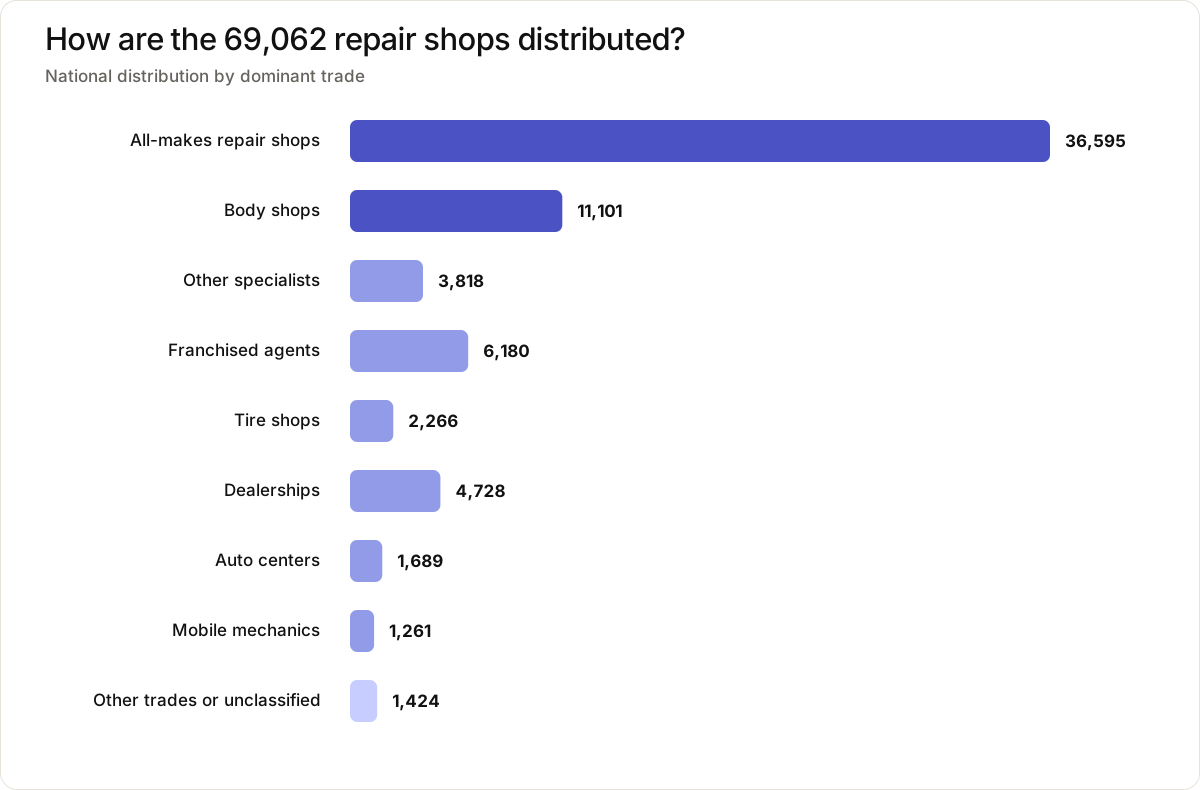
| Type of business | Repair shops | Share |
|---|---|---|
| All-makes repair shop | 36,595 | 53.0% |
| Body shop | 11,101 | 16.1% |
| Franchised agent | 6,180 | 8.9% |
| Manufacturer dealership | 4,728 | 6.8% |
| Specialist, other | 3,818 | 5.5% |
| Tire shop | 2,266 | 3.3% |
| Auto center | 1,689 | 2.4% |
| Mobile mechanic | 1,261 | 1.8% |
| Unclassified | 817 | 1.2% |
| Auto glass specialist | 570 | 0.8% |
| Quick-service shop | 37 | 0.1% |
| Total | 69,062 | 100.0% |
The data behind figure 2
| Type | Businesses |
|---|---|
| All-makes repair shops | 36,595 |
| Body shops | 11,101 |
| Franchised agents | 6,180 |
| Manufacturer dealerships | 4,728 |
| Other specialists | 3,818 |
| Tire shops | 2,266 |
| Auto centers | 1,689 |
| Mobile mechanics | 1,261 |
| Other trades or unclassified | 1,424 |
| Total | 69,062 |
The 36,595 all-makes repair shops and 11,101 body shops together make up 47,696 repair shops, or 69.1% of the market. This concentration explains why these two trades form the first pool for a national strategy, while the other formats call for more specialized approaches.
The types "franchised agent" and "manufacturer dealership" total 10,908 businesses, against 11,278 for the manufacturer channel. The gap of 370 corresponds to manufacturer-channel businesses whose dominant trade is classified otherwise, mostly body shops, all-makes repair shops and specialists.
Specialists are not a uniform block. The type "specialist, other" gathers 3,818 businesses; tire shops, auto centers and glass specialists have their own categories. For a commercial strategy, that distinction is often more useful than a binary split between "repair shop" and "not a repair shop", because needs in parts, equipment, software or customer acquisition differ sharply by dominant trade.
Level 5. The banner: an affiliation is not a manufacturer channel#
A banner is a service network displayed and proven locally. It can bring a commercial brand, group purchasing, methods, marketing or shared services. It does not automatically change the channel: a repair shop under an all-makes banner stays independent as long as it is not attached to a manufacturer.
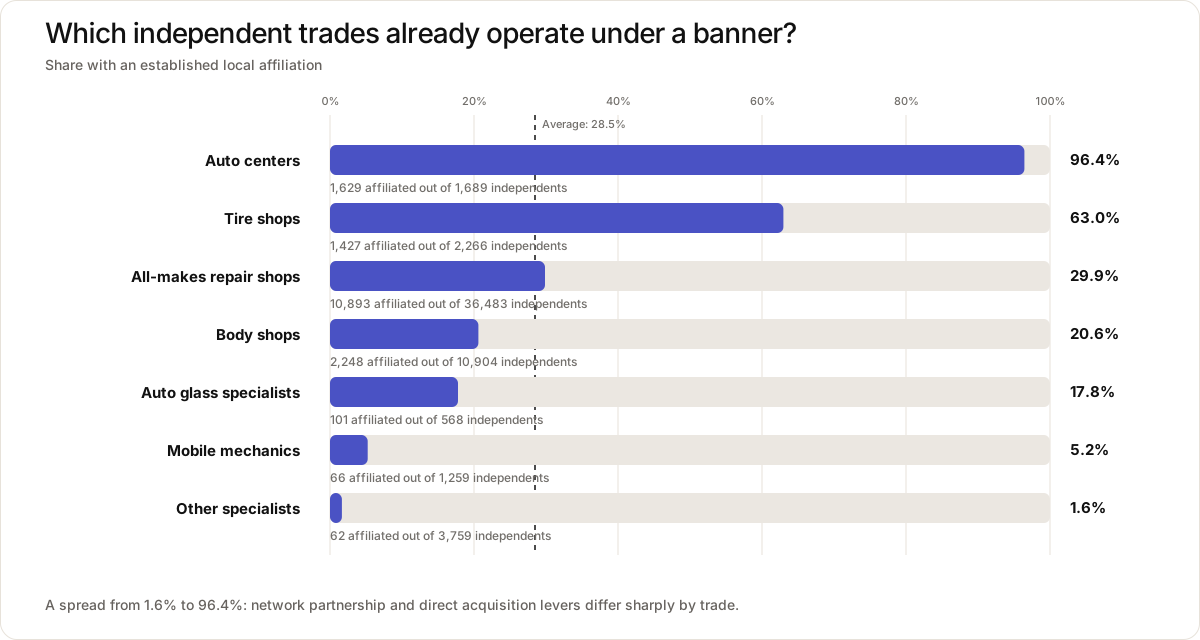
Across the national market, 16,654 repair shops have an established banner or service network and 52,408 have none proven. Among the 57,784 businesses in the independent channel, 16,449 have an established affiliation, or 28.5%. This category describes a proven local link, membership, license or presence in a service network, and not necessarily a franchised storefront. The absence of a recorded banner does not mean the repair shop works entirely alone; it means no local affiliation is established in the available data.
The data behind figure 3
| Trade | Affiliated | Independents | Share |
|---|---|---|---|
| Auto centers | 1,629 | 1,689 | 96.4% |
| Tire shops | 1,427 | 2,266 | 63.0% |
| All-makes repair shops | 10,893 | 36,483 | 29.9% |
| Body shops | 2,248 | 10,904 | 20.6% |
| Auto glass specialists | 101 | 568 | 17.8% |
| Mobile mechanics | 66 | 1,259 | 5.2% |
| Other specialists | 62 | 3,759 | 1.6% |
| Other types, incl. unclassified | 23 | 856 | 2.7% |
| Independent channel average | 16,449 | 57,784 | 28.5% |
The average hides major gaps. An affiliation is established for 1,629 auto centers out of 1,689 and 1,427 tire shops out of 2,266, against 10,893 all-makes repair shops out of 36,483, 2,248 body shops out of 10,904 and only 62 "other" specialists out of 3,759. The first commercial pool therefore counts 25,590 repair shops that are all-makes, independent and have no established banner. For a sales or operations leader, these gaps separate two logics: partnering with networks that already provide structure, or addressing a local fabric that remains highly dispersed.
The ten most frequent banners across the national market are:
| Banner | Businesses |
|---|---|
| AD, repair and body shops | 2,517 |
| Motrio | 1,512 |
| Eurorepar Car Service | 1,462 |
| Top Garage | 1,025 |
| Bosch Car Service | 752 |
| Avatacar | 697 |
| AutoPrimo | 626 |
| Garage Premier | 625 |
| Point S | 612 |
| Speedy | 535 |
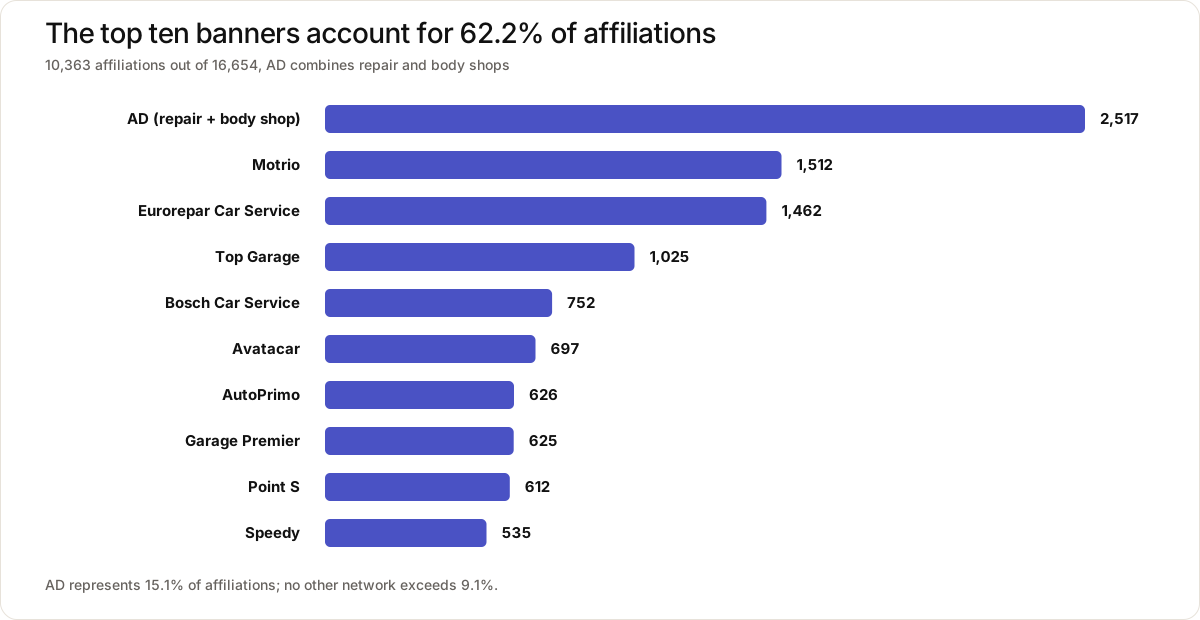
To read commercial presence at brand level, AD here combines the 1,863 AD repair shops and the 654 AD body shops, for 2,517 businesses. The two subsets stay separate in the analysis so that their trade specialization is preserved; they are merged only in this market view.
For every banner, only an established local affiliation, membership, license or current presence in the network, is counted. Using a piece of software, a quoting tool or a booking service is not enough; this rule applies in particular to Avatacar.
This reading avoids two mistakes. The first is adding banners and independents as if they were separate populations: a large share of businesses under a banner belongs precisely to the independent channel. The second is inferring an affiliation from the name or the type of activity alone, when a banner is a local relationship that can change.
For a network head office, the useful figure is therefore not only the number of repair shops already affiliated. Proven presence, absence of proof and real potential by type of business must be told apart. For a supplier, the banner can shed light on the buying mode or the commercial setup, but type and channel remain essential to understand the need.
Level 6. Where are repair shops concentrated?#
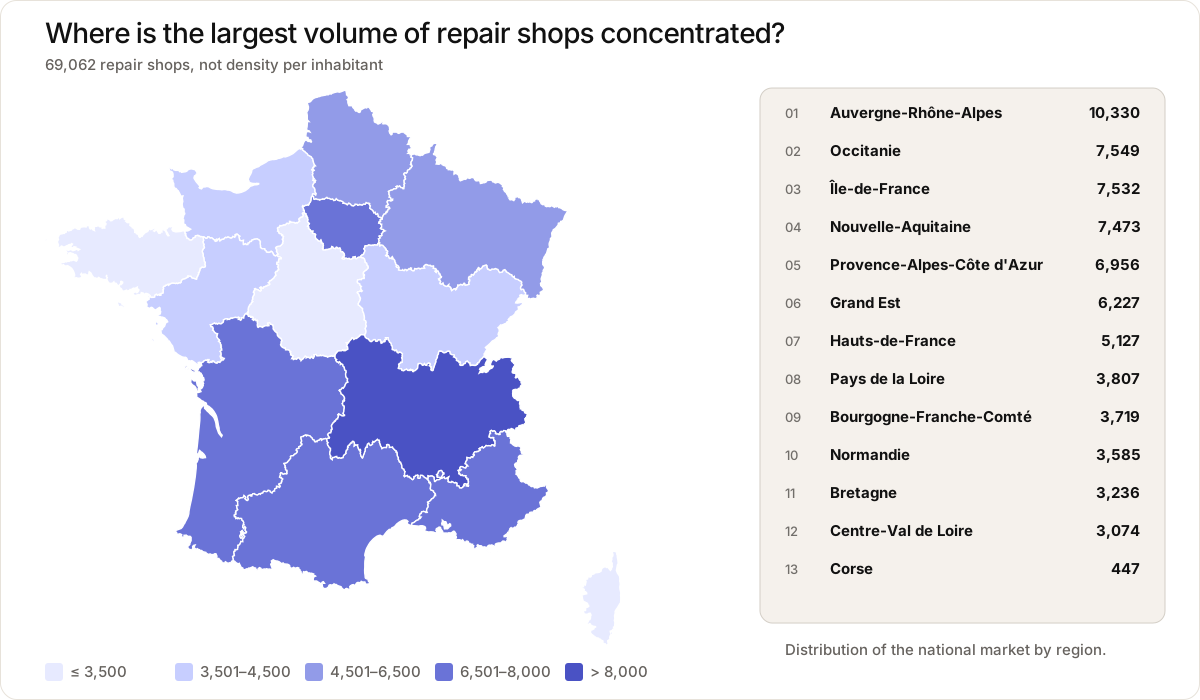
The regional view distributes the 69,062 repair shops across the thirteen mainland regions. A high volume does not mean a higher density per inhabitant.
The data behind figure 5, the thirteen regions
| Region | Repair shops | Share | Independents | Manufacturer |
|---|---|---|---|---|
| Auvergne-Rhône-Alpes | 10,330 | 15.0% | 8,429 | 1,901 |
| Occitanie | 7,549 | 10.9% | 6,540 | 1,009 |
| Île-de-France | 7,532 | 10.9% | 6,560 | 972 |
| Nouvelle-Aquitaine | 7,473 | 10.8% | 6,286 | 1,187 |
| Provence-Alpes-Côte d’Azur | 6,956 | 10.1% | 6,074 | 882 |
| Grand Est | 6,227 | 9.0% | 5,143 | 1,084 |
| Hauts-de-France | 5,127 | 7.4% | 4,364 | 763 |
| Pays de la Loire | 3,807 | 5.5% | 2,978 | 829 |
| Bourgogne-Franche-Comté | 3,719 | 5.4% | 3,025 | 694 |
| Normandie | 3,585 | 5.2% | 2,920 | 665 |
| Bretagne | 3,236 | 4.7% | 2,595 | 641 |
| Centre-Val de Loire | 3,074 | 4.5% | 2,479 | 595 |
| Corse | 447 | 0.6% | 391 | 56 |
| Total | 69,062 | 100.0% | 57,784 | 11,278 |
Auvergne-Rhône-Alpes leads with 10,330 repair shops. Then come Occitanie with 7,549, Île-de-France with 7,532, Nouvelle-Aquitaine with 7,473 and Provence-Alpes-Côte d’Azur with 6,956. Grand Est counts 6,227 repair shops and Hauts-de-France 5,127.
The top five regions gather 39,840 repair shops, or 57.7% of the national market. For a commercial or operations leader, this concentration gives an order of priority, but not yet a relative potential: a heavily populated region can hold many repair shops without being the best equipped per inhabitant or per vehicle on the road.
The full ranking sits directly beside the map. Comparing relative coverage across regions would require another denominator, such as population or the vehicle fleet.
How to use these figures for a market study#
Sizing an addressable market
The first choice is defining what the offer can actually serve. An offer aimed at all independent repair shops can take the 57,784 independents as a first benchmark; an offer reserved for general workshops must then isolate the all-makes repair shops. A solution fitted to manufacturer processes may add all or part of the 11,278 businesses in that channel. An offer in roadside assistance, inspection or recycling must instead start again from the extended universe and select the relevant activities outside the core.
Building a commercial segmentation
A robust segmentation combines several axes instead of looking for a single label. The channel indicates the mode of attachment, the type describes the dominant trade, the banner reports the network setup, the region places the point of activity. An independent all-makes shop under a banner in Bretagne does not share the commercial context of a manufacturer dealership in Île-de-France, or of an independent body shop in Provence-Alpes-Côte d’Azur.
This structure makes it possible to prepare sharper messages, to set coherent territorial targets, and to compare portfolios on consistent bases. It also avoids treating as errors the cases where several dimensions are true at once: independent and under a banner, body shop and repairer, dealership and workshop.
Adapting a territorial strategy
Regional volumes give a first reading of market scale. They can guide how teams are spread, the order of campaigns, or the comparison of territorial portfolios.
This reading does not measure density. Depending on the decision at hand, it gains from being completed with the vehicle fleet, population, miles driven or maintenance demand.
Tracking a living market
A business can open, close, move, change banner or join a manufacturer. The dominant type can also shift as a workshop develops body work, tires, sales or a specialty. A dated snapshot must therefore be kept as such.
To track these changes, the date, the counting unit and the definitions must travel with every indicator. Comparing successive editions on a constant scope then makes the transformation of the repair base readable.
How to build a repair-shop prospect list#
A useful prospect list does not start from the 101,989 automotive activities without distinction. It starts from the market matching the offer (69,062 repair shops and workshops, or 57,784 independents when the manufacturer channel is not targeted), then combines trade, channel, banner and region. This segmentation avoids treating an independent all-makes shop, a body shop under a banner and a manufacturer dealership the same way.
The market size calculator helps frame that scope. The auto parts case shows how this reading turns into commercial targeting without mistaking an automotive directory for a list of genuinely relevant accounts.
Frequently asked questions about repair shops in France#
How many independent repair shops are there in France?
The study counts 57,784 independent repair shops in mainland France. That figure includes independent workshops under a service banner when they are not attached to a manufacturer.
What is the difference between an independent repair shop and an all-makes independent?
"Independent" is a channel, "all-makes independent" is a type of activity. An all-makes independent is a general multi-brand mechanic: the term says nothing about its channel. The independent channel also includes body shops, tire shops, auto centers and specialists.
Does a banner mean the repair shop is no longer independent?
No. In this observatory, "independent" means the repair shop does not belong to a manufacturer's official channel. An all-makes banner can supply a commercial brand, group purchasing, tools or marketing without turning the member into a manufacturer's agent. Across the national market, 16,449 independent repair shops out of 57,784 have an established banner.
Why do the figures from ANFA, INSEE and Scalon differ?
Because they count neither the same unit, nor the same scope, nor the same year: ANFA counts among other things 53,000 employer locations in passenger-vehicle maintenance, INSEE 57,283 enterprises in sector 452 in 2021, and Scalon counts 69,062 local repair-shop points in 2026. A company operating ten repair shops can count as one enterprise at INSEE but as ten points of activity in this observatory.
What is the difference between an agent and a dealership?
The agent is a repairer officially tied to a brand, generally oriented toward aftersales. The dealership has a local setup for new-vehicle distribution, often completed by a workshop. Both belong to the manufacturer channel when a current attachment is established.
Is an auto center a repair shop?
Yes, when it has a maintenance or repair workshop. Its format stands out through the combined presence of a retail space open to the public. It belongs to the core of workshops, even though its business model differs from a traditional all-makes independent.
Why are vehicle inspection centers not counted as repair shops?
Vehicle inspection examines the car but does not carry out routine repair. It belongs to the automotive ecosystem and may appear in the extended universe, while remaining outside the core for an analysis centered on workshops.
Are closed repair shops counted?
No. Every benchmark in this study covers businesses active as of August 31, 2026. A closed, wound-up or dormant repair shop is removed from the count. That is what makes editions comparable year over year: a base that accumulated closures would grow mechanically at every pass, and would measure the history of the market rather than its current state.
Which regions hold the largest repair-shop volumes?
Auvergne-Rhône-Alpes leads with 10,330 repair shops, ahead of Occitanie with 7,549, Île-de-France with 7,532, Nouvelle-Aquitaine with 7,473 and Provence-Alpes-Côte d’Azur with 6,956. These headcounts are not densities per inhabitant.
Method#
Counting unit
The unit is the local point of activity: a business open to the public, identified by a name, a normalized address and a geocoded position. A company running ten workshops counts as ten. This unit differs from the legal unit and from the administrative establishment of the Sirene register, which explains most of the gaps with public statistics.
Building the universe
The universe of 101,989 listings is built with no entry filter on the activity code: neither the APE code nor the categories of online directories reliably describe the trade actually carried out. Collection combines two independent procedures, a systematic map sweep of the territory and thematic queries run municipality by municipality, pursued until saturation, meaning until an extra pass no longer yields a new listing. The search vocabulary covers every local automotive activity, several dozen categories in all.
Three treatments follow: removal of businesses flagged as closed, deduplication of multiple listings for the same site by key matching (normalized address, position, phone, company name), and removal of listings with no verifiable contact channel.
Qualification
Qualification works as a funnel: at each step, each business is kept or set aside. The count moves from 101,989 businesses in the universe to 69,062 repair shops and workshops, then 57,784 independents, 36,483 independent all-makes shops and 25,590 all-makes shops with no established banner.
Each business is described by three independent variables: the type, its dominant trade within a closed eleven-value nomenclature; the channel, independent or manufacturer; the banner, drawn from a reference list of service networks. Verdicts come from a classification pipeline assisted by language models, constrained by the nomenclature and by explicit decision rules: a manufacturer mandate is never inferred from a trading name, a banner is never inferred from the use of a booking tool.
Each business is recategorized regardless of its declared activity code and of its directory category, from a body of cross-checked evidence: customer reviews, photos, website, professional and specialized directories, legal registers. Every verdict rests on excerpts from that evidence, whose presence is checked automatically. A verdict without sufficient evidence is never forced: the business stays "unclassified", and that remainder is published.
Quality control
A random sample of 100 businesses is reviewed by two independent reviewers, each without access to the other's conclusions, on type, channel and banner. Difficult cases are arbitrated by a third reviewer. Each audited verdict receives one of four statuses: supported, defensible alternative, certain error, unresolved. An error is only recorded as certain when the sources make the verdict impossible and all three opinions converge. Result: no certain error out of 100, which puts the certain-error rate below 3% at a 95% confidence level.
Reconciliation with public sources
Totals are checked, region by region, against the Sirene register and against ANFA and INSEE publications. Sirene lists nearly 108,000 active establishments in motor-vehicle maintenance and repair. The Observatory's extended universe lands in the same range: 101,989 businesses, once closed businesses and listings with no verifiable activity are removed. The collection therefore finds the same fabric the register describes. The gap with the 69,062 repair shops comes from recategorization, which sets aside businesses whose actual activity is not repair: standalone vehicle inspection, car wash, sales without a workshop, recycling.
Consolidation and rounding
Headcounts are consolidated at national level, then broken down by channel, type, banner and region on that same total. Shares are computed on the displayed headcounts and rounded to one decimal. Some fine cross-tabulations may differ by a few units from the sum of their components.
Limitations
- Snapshot as of August 31, 2026: a closure not yet visible in public sources may remain, a very recent opening may be missing.
- The type keeps the dominant trade: a mixed workshop is filed under its main visible activity.
- The banner measures a locally proven affiliation. Network headcounts may therefore differ from those published by the networks themselves, which count members under their own rules.
- Mainland France only; overseas territories will be covered separately.
- Regional volumes are headcounts, not densities.
Edition history
- September 2, 2026: first publication. The detailed tables covered a scope of 60,957 businesses.
- September 3, 2026: every segmentation is brought back to the national total of 69,062 repair shops, the single denominator of the study. National totals unchanged.
- September 14, 2026: detailed method, dated and linked sources, label corrections. No headcount changed.
What to remember#
The French market does not come down to a single number. 101,989 describes the extended automotive universe; 69,062 the repair shops and workshops; 57,784 the independents, of which 36,483 all-makes shops and, among them, 25,590 with no established banner; 11,278 the manufacturer channel; 32,927 the adjacent, outside-the-core or unclassified activities. The segmentations by trade, banner and region all use the same total of 69,062, allowing readers to move from the overall market to a commercial target without changing denominators.
To reach a decision, the safest hierarchy stays the same: choose the right universe, isolate the repair shops, select the channel, specify the type, verify the banner, then compare territories. That discipline of the denominator is what turns a directory into a genuine reading of a market.
The six levels of reading, the five figures, the method and the sources. Free, in exchange for an email address.